
What if children didn’t just learn because they had to, but looked forward to discovering something new every day?
What if children didn’t just learn because they had to, but looked forward to discovering something new every day? Joyful learning begins when curiosity, discovery and enjoyment become part of the learning process.
Joyful learning, of course, does not mean making every lesson a game. It means creating an environment where children feel safe to ask questions, explore ideas, make mistakes, and discover answers for themselves. When children enjoy learning, they are more likely to participate, remember what they learn, and develop a lasting interest in knowledge.
At Nalanda International School, we believe that meaningful learning should engage the mind as well as the imagination. Our approach combines student-centred learning with activities, projects, sports, arts and experiences that encourage children to learn by doing.
For parents looking for the best school for joyful learning in Vadodara, this distinction matters. A joyful learning environment can help children develop confidence, curiosity, and a genuine love for learning. These are qualities that go far beyond academic performance.
What Is Joyful Learning?
Joyful learning is an approach where children actively participate in the learning process and find meaning in what they are discovering. It connects knowledge with curiosity, creativity, collaboration, and real-life experiences.
As a joyful learning school in Vadodara, therefore, Nalanda looks beyond simply completing the syllabus. It creates opportunities for children to question, experiment, create, discuss, and apply what they learn.
Learning Through Play
Play is one of the earliest ways children understand the world. Learning through play means allowing children to explore concepts through games, activities, stories, objects and hands-on experiences.
As a play based learning school in Vadodara, we use this natural curiosity to make early learning more engaging. At Nalanda, pre-school children experience learning through stories, songs, puppetry, Montessori methods, blocks, art, music, and field trips.
Making Learning Active
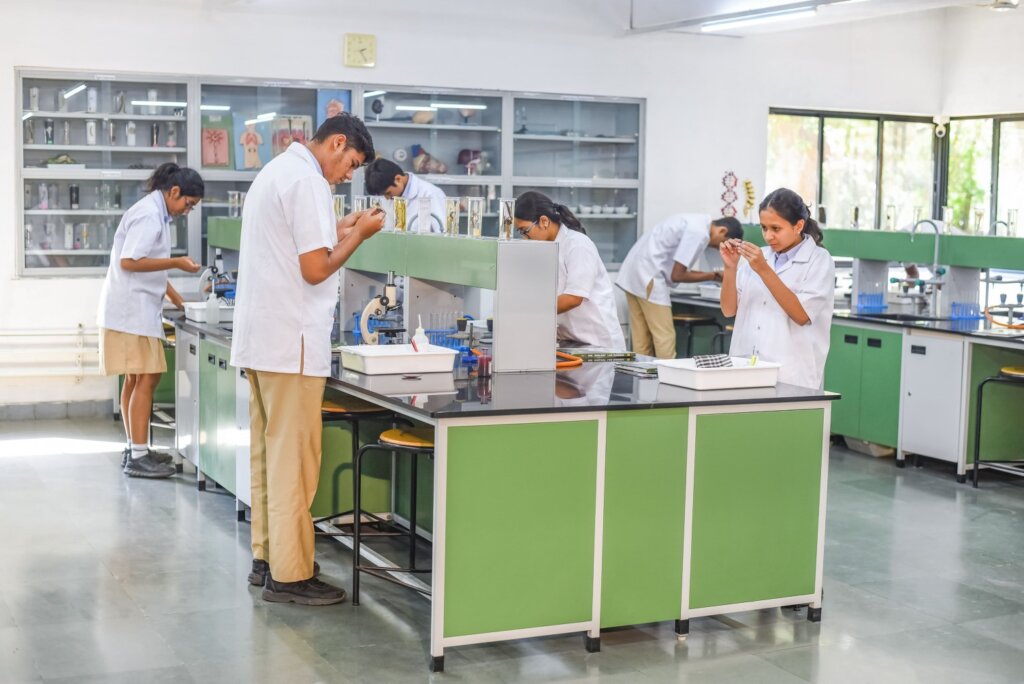
Children learn differently when they are actively involved. Active learning means learning by doing, through experiments, projects, discussions, presentations and practical experiences rather than only listening to a teacher.
Nalanda, being an activity based learning school in Vadodara, offers children more opportunities to apply their knowledge. Here, project-based and experiential approaches complement classroom teaching and help students connect ideas with the world around them.
Giving Children Space to Explore
A joyful classroom is rarely silent. It has a healthy buzz of questions, conversations, ideas, experiments, and discoveries as children actively engage with their learning.
At Nalanda International School, teachers encourage students to ask questions, share ideas and participate in activities. This approach supports curiosity and helps children become confident participants in their own learning.
The Role of Creativity
Creativity gives children another way to understand and express what they learn. Art, craft, music, dance, drama, and woodwork allow students to experiment with ideas and create something of their own.
For a child centred learning school in Vadodara, these experiences are not simply recreational. They help children develop confidence, expression, problem-solving abilities and an appreciation for different forms of creativity.
Joyful Learning and Holistic Development
Children are more than their rank or examination scores. Their confidence, relationships, physical well-being, creativity and emotional development are equally important.
This is why joyful learning is closely connected to holistic education. At Nalanda International School, academics exist alongside sports, arts, leadership opportunities, nature camps, community service, and other co-curricular experiences that support the development of the whole child.
Learning with Friends
Learning becomes more enjoyable when children learn with and from one another. Group projects, discussions, performances and competitions give students opportunities to collaborate, listen and contribute.
Such experiences also develop communication and teamwork skills. They help children understand that learning is not always about having the fastest answer; sometimes, it is about finding an answer together.
Making Mistakes Part of Learning
Children can hesitate to participate when they are afraid of getting an answer wrong. A joyful learning environment changes this mindset by treating mistakes as opportunities to learn. When students know that they can try, make mistakes and try again, they become more willing to experiment. This builds resilience and helps develop independent learners who are comfortable facing new challenges.
When students know that they can try, make mistakes and try again, they become more willing to experiment. This builds resilience and helps develop independent learners who are comfortable facing new challenges.
The Parent’s Role in Joyful Learning
Parents can extend joyful learning beyond school by encouraging curiosity at home. Simple activities such as reading together, cooking, gardening, visiting museums or discussing everyday observations can turn ordinary moments into learning experiences.
The goal is not to turn home into another classroom. It is to show children that learning is part of everyday life and can happen anywhere.
Why Joy Matters for the Future
Children who enjoy learning are more likely to remain curious as they grow. They learn to ask questions, seek answers and adapt when they encounter something new.
For parents searching for the best ICSE school in Vadodara, this is an important consideration. A strong academic foundation matters, but so does developing the curiosity, confidence, and adaptability needed for a changing world.
The Nalanda Approach
Nalanda International School brings together academic learning and experiences that encourage children to explore, participate and create. The ICSE Curriculum provides a strong academic foundation, while projects, activities, sports, arts, field trips and experiential opportunities bring learning to life.
As a child centred learning school in Vadodara, Nalanda believes that children learn best when they are active participants. This approach makes learning more meaningful while supporting the confidence, curiosity and independence that form the foundation of holistic development.
Frequently Asked Questions
Joyful learning is an approach that makes children active participants in learning by combining curiosity, discovery, creativity, collaboration and meaningful experiences.
Play based learning allows children to explore concepts naturally through games, activities and hands-on experiences. It can strengthen curiosity, creativity, communication, and problem-solving skills.
Parents can encourage reading, conversations, creative activities, gardening, cooking, games, and real-world experiences without making every activity feel like a formal lesson.
Nalanda combines student-centred learning with projects, activities, sports, arts, field trips, nature camps and experiential learning to make education engaging and meaningful.
Conclusion
Joyful learning is not just about making education easier. It is about making children want to learn. When curiosity is encouraged and children are given opportunities to explore, create, question and participate, learning becomes an experience they can connect with.
At Nalanda International School, we believe that the best education prepares children not only to perform well but also to remain curious, confident and engaged throughout life. For families seeking the best school in Vadodara or an experiential learning school in Vadodara, our approach brings together academic rigour, joyful experiences and holistic education. Because when children enjoy discovering the world, every day can become an opportunity to learn.
